

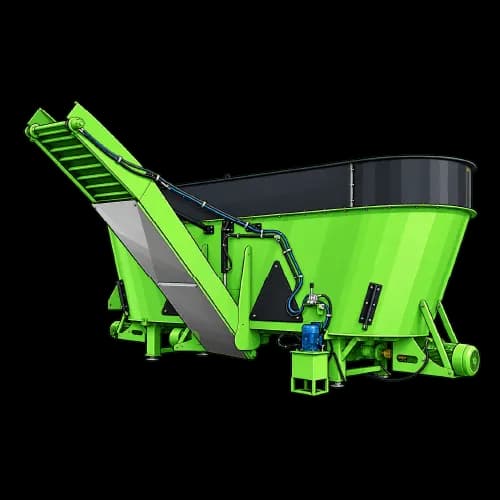
The horseshoe blade for mixer feeders has a curved edge, providing a more general cutting pattern compared to serrated blades, and is a common choice in mixed rations that include both silage and dry forage.
The efficiency of the blade directly affects mixing time. If you are mixing for a longer duration to achieve the same quality of ration, the edges of the blades are likely worn.
At a glance
- Suitable for mixed rations of silage and dry forage.
- Replacement should be done in sets and symmetrically to maintain tank balance.
- After replacement, the optimal mixing time usually decreases and needs to be readjusted.
- Connection should be made with bolts and nuts of appropriate strength class and recommended torque.
Technical specifications
| Blade type | Horseshoe (curved edge) |
|---|---|
| Application | Vertical mixer feeder |
| Cutting pattern | General, suitable for mixed rations |
| Installation | On the edge of the auger with bolts and nuts |
| Replacement | In sets and symmetrically |
| Brand | Techno Dam San'at (TDS) |
What units is it suitable for?
This blade is suitable for units that produce mixed rations where the silage component is significant. In rations with a very high proportion of long dry alfalfa, the corrugated blade usually has better engagement with the fibers.
Dimensions, thickness, and hole spacing must exactly match your machine model. Before placing an order, send the model and year of manufacture of the machine, the dimensions of the current part, and a clear photo of the installation location to the technical expert. The visual similarity of parts from different models is the most common cause of incorrect purchases in this field.
Features and advantages of construction
- Curved cutting edge with a uniform cutting pattern throughout operation.
- Can be installed on common vertical mixer feeder models with matching dimensions.
- Supplied as a complete set to maintain tank balance.
- Possibility of supply along with connection bolts and nuts of appropriate strength class.
Check these items before purchasing
- Measure the dimensions, thickness, and center-to-center spacing of the current blade holes.
- Record the model and year of manufacture of the machine from the registration plate.
- Review your ration composition to determine the appropriate blade type.
- Specify the number of blades in a complete set.
- Also check the condition of the connection bolts and seating holes.
Related products
Buying guide and related articles
- Types of Mixer Feeder Blades; Horseshoe, Axe, and Corrugated
- When should I replace the mixer feeder blade?
- Screw and nut of the mixer feeder blade; choosing a secure connection
- Ordering spare parts for the mixer feeder; identifying the correct model
Frequently Asked Questions
When should I replace the blade?
When you need to increase the mixing time to achieve the same quality of the ration, or when long forage stems remain after the usual time.
Can I just replace a few blades?
It is not recommended. Replacing part of the set disrupts the balance of the tank and can lead to vibration and damage to the auger bearings.
What is the difference between a crescent blade and a serrated blade?
The serrated blade has a toothed edge and engages long fibers better; the crescent blade has a more general cutting pattern and is more suitable for mixed rations.
Should I change the mixing time after replacement?
Usually yes. A new blade has more cutting efficiency, and continuing with the previous time can lead to over-mixing of the ration.
What information is needed for ordering?
Dimensions and thickness of the current blade, hole spacing, machine model, and a clear photo of the installation location.
To accurately match the blade with your machine model, send the dimensions of the current part and a photo of the installation location to our experts.